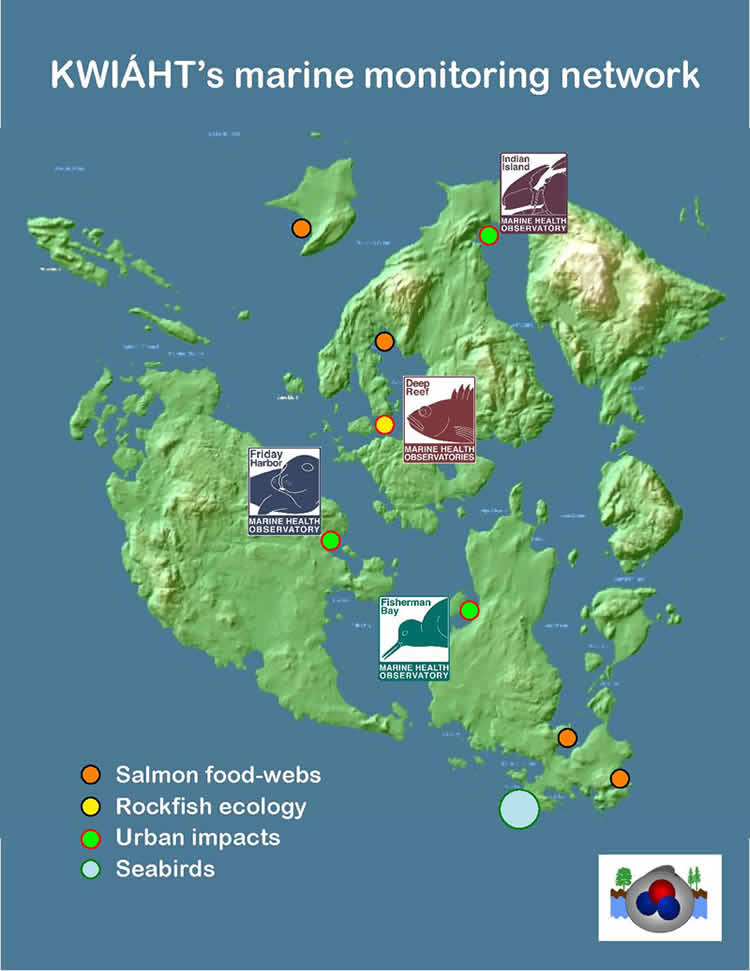
San Juan Islands Marine Monitoring Network
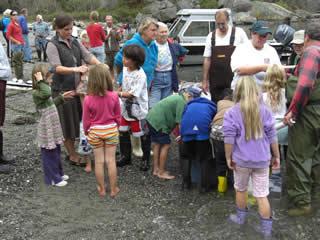
Students join adult volunteers on the beach
With over 150 islands and 400 miles of shoreline, the San Juan Archipelago is profoundly tied to its marine environment. In spring and summer large aggregations of "forage fish" (sand lance, smelt, herring), shrimp and crabs attract juvenile Pacific salmon, Orcas (Killer whales), Minke whales, and seabirds from throughout the Salish Sea. New roads and homes are mainly along the shoreline, however, and recreational boating and fishing are increasing rapidly. Eelgrass meadows appear to be shrinking, and rockfish have declined sharply. In cooperation with public land managers, Kwiaht has developed seven community-based volunteer teams on four of the San Juan Islands to conduct long-term monitoring of sensitive species and nearshore food webs. Some monitoring sites are relatively undisturbed and three are located in Urban Growth Areas. Each team conducted baseline surveys and chose its own set of indicators and data collection methods. Teams continue to recruit and train new members, and expand their research agendas, while sharing data and maintaining a commitment to scientific integrity.
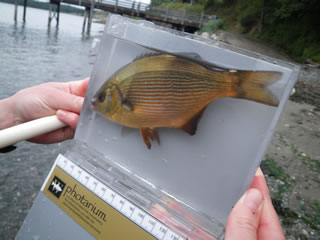
Striped Perch
To a growing extent, community teams also engage in stewardship activities such as removal of invasive shrubs, designing and demarcating access-limiting trails, and most important of all, greeting and briefing recreational visitors and schoolchildren (more than 6,000 visitors in 2013 alone).
Kwiáht gratefully acknowledges the support of The Russell Family Foundation, National Fish and Wildlife Foundation, Charlotte Martin Foundation, Benedict Family Foundation, Raynier Foundation and Horizon Foundation in designing and organizing these programs, and the local volunteers and individual donations that maintain them.